Biodyne Environoc 301 (liquid & Innocubeads)
Stocked or sourced on request — ask the counter.
The dirty secret of food production is downstream: grease traps, drains and effluent carrying fats and organics that build, block and smell — in Namibian heat, quickly. Biodyne’s Environoc programme gives food plants a biological maintenance crew: 301 digesting fats and proteins in traps and drains continuously, 501 attacking organic sludge, both compatible with food-adjacent placement because the cultures are non-pathogenic.
Culture documentation (non-GMO, non-pathogenic) is available for food-safety and environmental files; dosing placement follows food-facility zoning practice.
Dose after the Saturday deep-clean, before the Sunday quiet — Namibian food plants that anchor the weekly Biodyne dose to that window give the culture its establishment head-start every single week.
The lines food & beverage buyers draw from this category most.
Stocked or sourced on request — ask the counter.
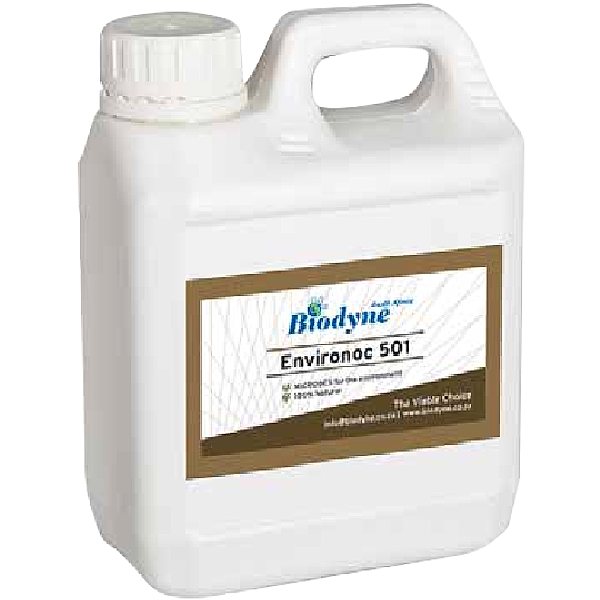
Microbial culture for composting, crop residue and effluent organics.
Available in501 L
In stock: Windhoek & Walvis Bay
Odour typically drops within two to three weeks of programme dosing as the culture establishes and hydrogen sulphide gets metabolised; grease-layer reduction follows over the next cycle. It is compounding maintenance, not a shock treatment — the trap gets progressively easier to live with, and pump-out intervals stretch accordingly.
Yes — the cultures are naturally occurring and non-pathogenic (documentation available for your audit file), and dosing happens in drains and traps, not product zones. Auditors generally prefer functioning biological drains to the alternative they usually find. Placement and records follow the same mapping discipline as your pest programme.
With sequencing, yes: dose after sanitation flows have passed, favour downstream trap chambers over floor gullies, and use Innocubeads for continuous re-seeding between chlorine events. Plants run both regimes side by side everywhere; the failures are scheduling failures, not compatibility ones.
Directly: fats, COD-driving organics and settleable solids fall as the biology digests the load before discharge — which is often the difference between staying inside a municipal agreement and paying surcharge rates. Pair 301/501 dosing with your existing screening, and measure monthly; the parameter trend is the business case.
Swachem Windhoek · 2-8 Walter Street, Southern Industrial Area, Windhoek · Tel 061 235 051 · Monday – Friday, 08:00 – 17:00
Served primarily from Swachem Windhoek — 061 235 051. SDS, grades and delivery scheduling included in the quote.